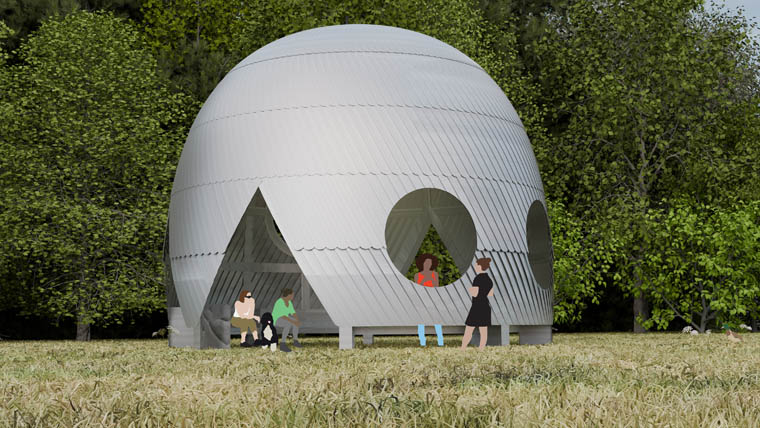
MOS, “Rendering of Art Omi Pavilion,” 2025. Digital rendering. Courtesy MOS
A Dome With Four Oculi, located within Art Omi’s Sculpture & Architecture park, proposes answers to the questions of what if the Pantheon were 8.1 times smaller, and instead of one oculus, it had four oculi, and if that foreboding, heavy front portico were replaced by three equilateral triangular cutouts around the perimeter, and it were no longer a monumental Roman temple for all the gods, but instead a temporary place for people to gather, dangle their legs, stop for a moment in the shade, take a photo, focus on their environment, relax, listen; what if it were less about looking upwards and instead about looking outwards, downwards, sideways, askew; what if it were a paper-thin, lightweight, woven, reflective aluminum-shingled, quasi-structural shell made from 3-mm-thick pieces stitched together like a crinoline dress, a kit of parts with 3,412 stainless-steel bolts, a silo top misplaced, a Bucky Fuller dome reimagined by Philip Guston; what if it is something that could time travel, that could lift off and land somewhere else, easily assemblable, reassemblable, something that could be installed by two to three people in eleven days during extreme weather events, and be played by a group of avant-garde percussionists—then maybe it would be something like this. Or maybe not at all.
A Dome With Four Oculi is a pavilion that provides a place to rest under a polished aluminum-shingled dome, in the shade or out of the rain. The dome literally reflects its surroundings, the porticos connect to park paths, and the four oculi frame the nature and other architectural pavilions.
In 2005, Michael Meredith and Hilary Sample cofounded MOS. Together they were the recipients of the Arnold W. Brunner/Katherine Edwards Gordon Rome Prize Fellows in Architecture (2023); the United States Artists Award in Architecture (2020); the Smithsonian Cooper Hewitt Design Museum National Design Award in Architecture (2015); the Global Holcim Award in Sustainable Architecture (2015); the American Academy of Arts and Letters Architecture Award, and the New York Architectural League Emerging Voices (2010). Sample and Meredith’s design work is held in the permanent collections of The Museum of Modern Art, the Art Institute of Chicago, Carnegie Museum of Art, San Francisco Museum of Modern Art, Yale Art Gallery, and in the special collections of the Harvard University Frances Loeb Library and Columbia University Avery Architectural and Fine Arts Library. Publications on MOS’s work include Everything All at Once (Princeton Architectural Press, 2013); MOS: Selected Works (Princeton Architectural Press, 2016); El Croquis 184 (2016); A Situation Constructed ... (AADR, 2016); 44 Low-resolution Houses (Princeton University, 2018); An Unfinished Encyclopedia of Scale Figures Without Architecture (MIT Press, 2019); Houses for Sale (Corraini Edizioni/Canadian Centre for Architecture, 2019); Casa No. 1–17 (Libria, 2020); Vacant Spaces NY (Actar Publishers, 2021); 2G (2021); A Book on Making a Petite École (Actar, 2023); Laboratorio de Vivienda (Actar, 2024); and Public Spaces NY (Park Books, 2025). Meredith and Sample designed educational and cultural institutions: Petit École in France; Laboratorio de Vivenda in Mexico; campus plan and art studio buildings for the Krabbesholm Højskole in Denmark; Ruth Arts Foundation and 9W Main Street in the United States; and collective housing across the US, Mexico, Paraguay, and Canada. Meredith is an architect and professor of architecture at Princeton University School of Architecture. Sample is an architect and professor of architecture at Columbia University Graduate School of Architecture, Planning and Preservation.