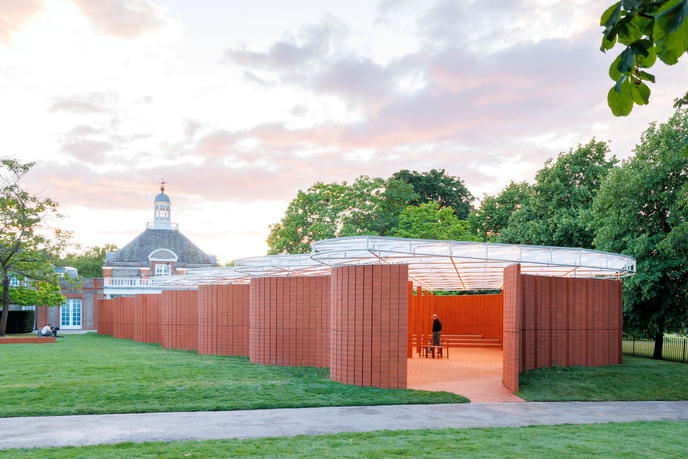
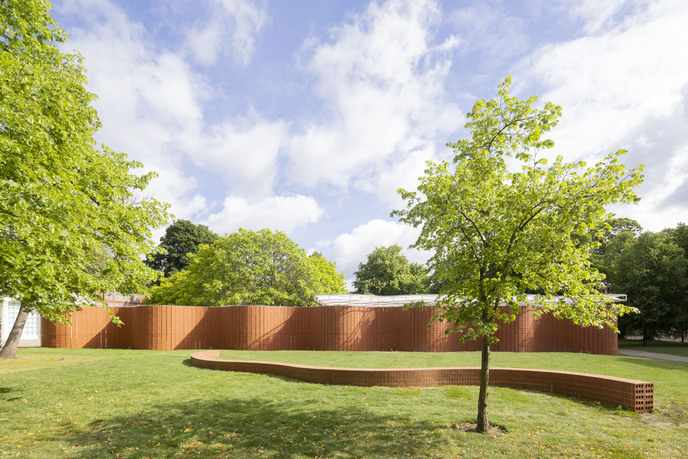
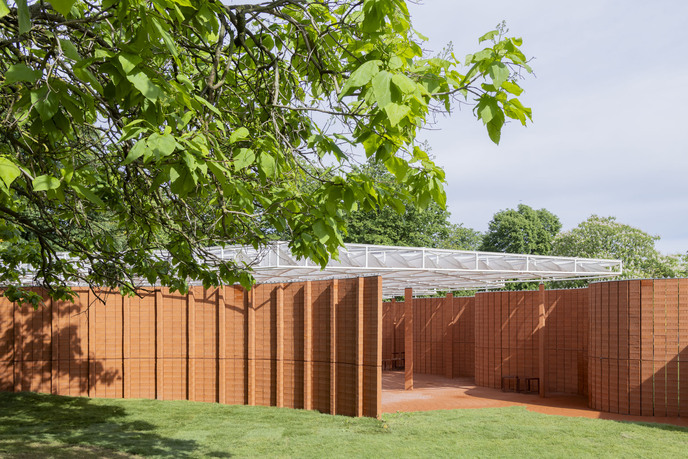
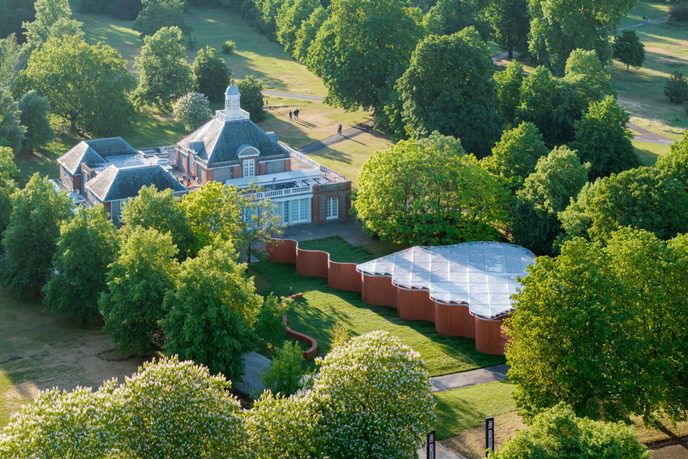
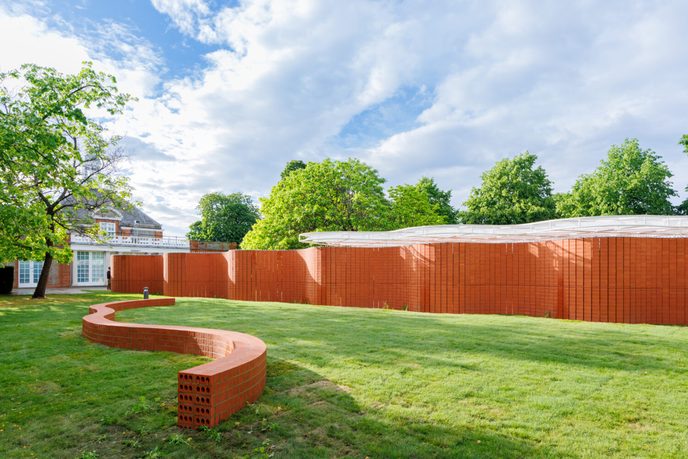
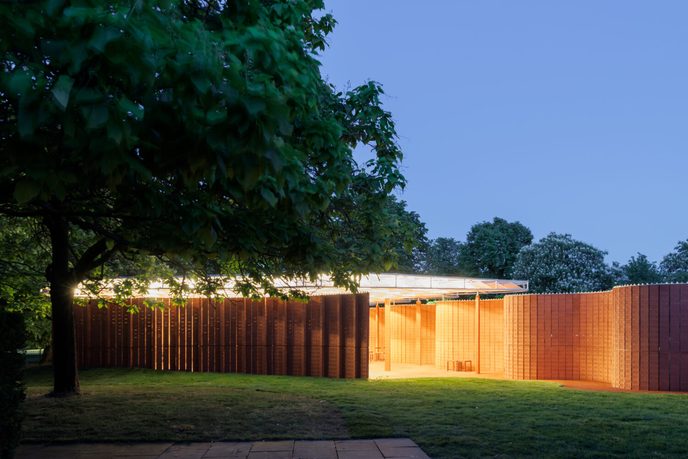
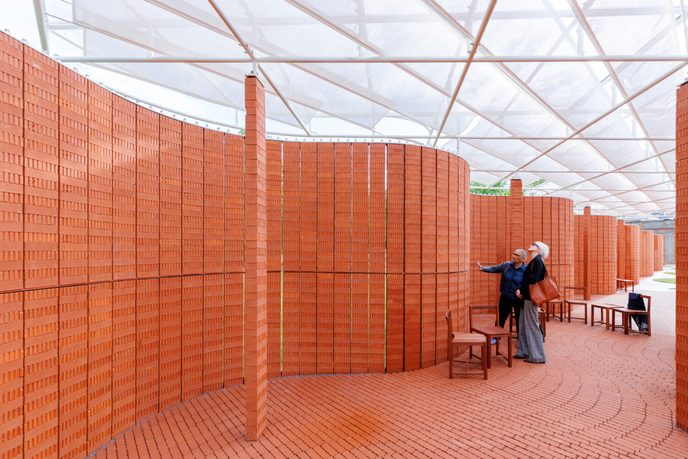
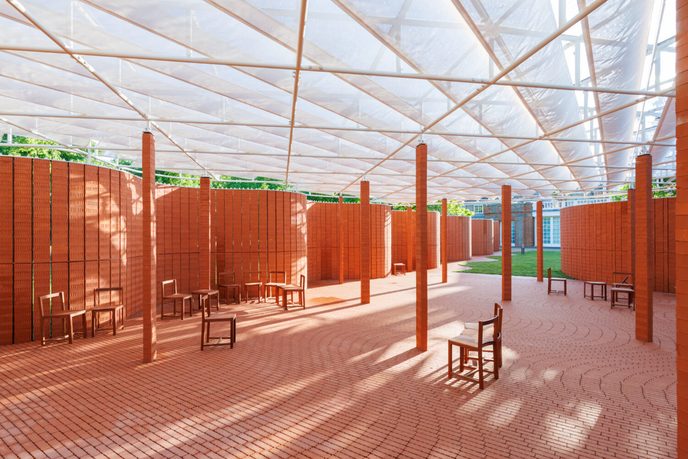
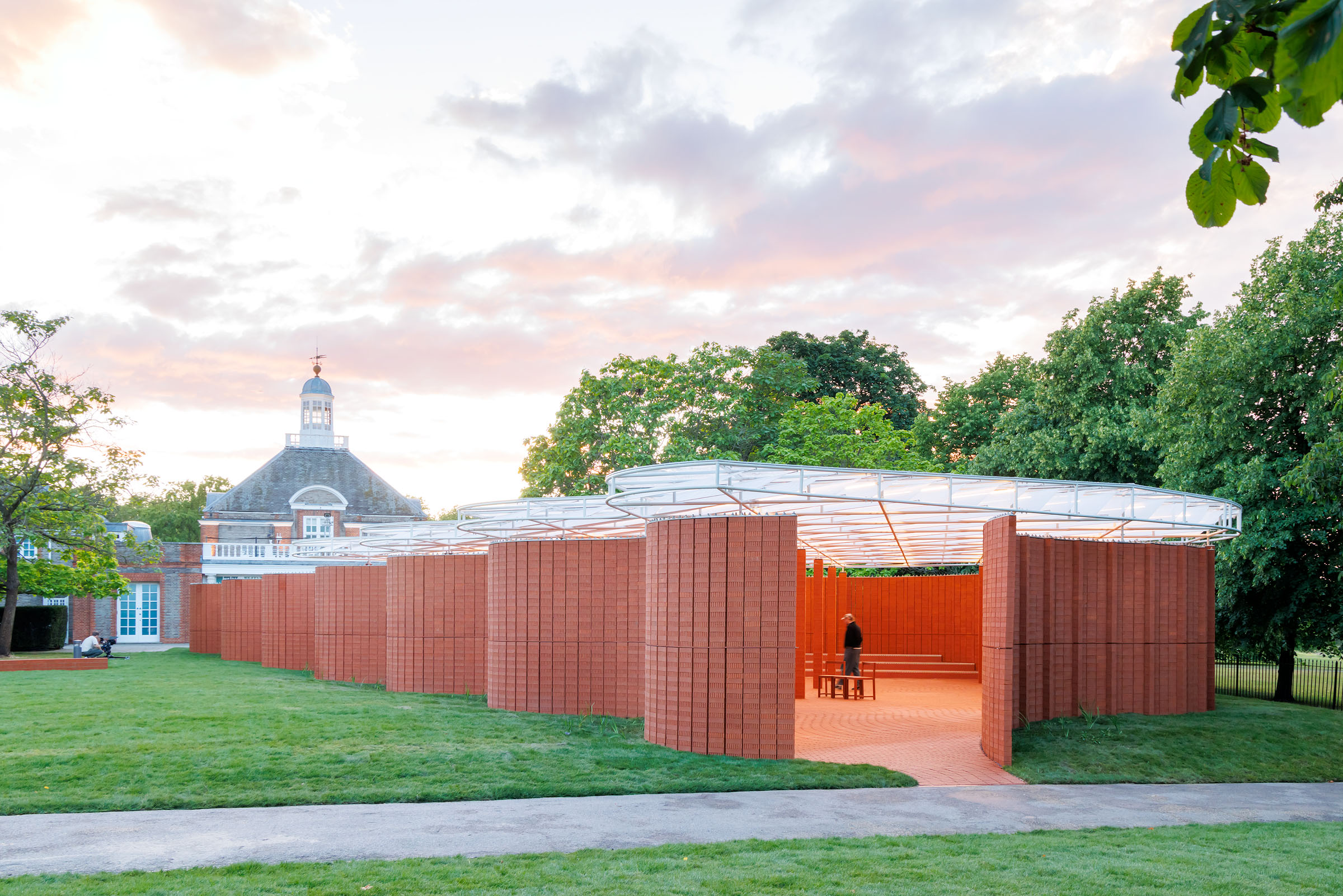
LANZA atelier (Isabel Abascal and Alessandro Arienzo), “a serpentine,” Serpentine Pavilion, London, 2026. Digital photograph. Copyright LANZA atelier. Courtesy Serpentine. Photo: Iwan Baan
For the 2026 Serpentine Pavilion, Mexico City–based LANZA atelier draws inspiration from the serpentine, or “crinkle-crankle,” wall, a traditional English garden feature composed of alternating curves. Its distinctive geometry provides lateral stability, allowing a single-brick-thick wall to use fewer bricks than a straight structure, while the form also nods to the nearby Serpentine lake. In dialogue with the surrounding landscape, a second wall curves around the tree canopy, and a translucent roof rests lightly on brick columns that evoke a grove of trees. Light and air permeate the pavilion, softening the boundary between enclosure and openness. Brick connects the design to English garden traditions and the façade of Serpentine South, originally built as a tea pavilion. Rhythmic columns shift the walls from opaque to permeable, transforming division into connection. LANZA atelier also designed locally made sapele hardwood chairs and stools, extending its integrated approach to furniture and architecture across scales.
LANZA atelier was founded by Isabel Abascal and Alessandro Arienzo in 2015 in Mexico City with the purpose of creating meaningful contributions to the beauty of the world. Since then, they have been nominated for the 2016 Ibero-American Architecture Biennial Award; the Mies Crown Hall Award for Emerging Architects, Illinois Institute of Technology, Chicago, in 2016 and 2022; and for the Brick Award 2021. The studio is one of the winners of the Young Architects Prize 2017 and the Emerging Voices Award 2023 from The Architectural League of New York which described their multimodal work as one that “expresses an inventiveness, a sensitivity to context, and a compositional refinement that spans scales and forms.” Following LANZA’s first solo show at the San Francisco Museum of Modern Art (SFMoMA) in 2018, their work has been exhibited at the 12th São Paulo Architecture Biennale (2019), the Lisbon Triennale (2019), the Concéntrico Festival in Spain (2021), and the Latin American Architecture Biennial (BAL) 2023.
Isabel Abascal studied architecture at the Universidad Politécnica de Madrid, Technische Universität Berlin, and at the Vastu Shilpa Foundation in Ahmedabad by B. V. Doshi. She was a design studio professor for six years at Escola da Cidade in São Paulo, Brazil. From 2015 to 2017, she was the executive director of the LIGA platform in Mexico City and coedited the book Exposed Architecture published by Park Books. Her proposal “Mother Architecture: Shaping Birth” was a Harvard Graduate School of Design 2023 Wheelwright Prize finalist and her project “Investigaciones sobre creación y procreación” was awarded the National Fund for the Arts Prize 2023.
Alessandro Arienzo studied architecture at the Universidad Iberoamericana in Mexico City. His work explores the possibilities within architectural practice through hand-drawing and publishing projects, such as the Housetypes book series. In 2017, he was a recipient of the National Fund for the Arts Young Creators Prize. With this grant, he developed an investigation on the Security and Citizen Participation Modules network. The resulting work became part of the SFMoMA permanent collection in 2018. Several of his designs have been showcased institutionally, like A family of 4, which is today part of the Denver Art Museum collection.
Bettina Korek is chief executive of Serpentine. Prior to arriving in London in 2020, she has two decades of experience as an arts leader in her hometown of Los Angeles, most recently as founding executive director of Frieze Los Angeles. In 2006, she founded ForYourArt, an organization that has expanded the place of art in everyday life in Southern California. ForYourArt has produced projects in collaboration with museums, brands and municipal governments, presenting work by hundreds of artists. She served on the Los Angeles County Arts Commission from 2011–20 and was the organization’s president in 2016–17.
Hans Ulrich Obrist is artistic director of the Serpentine in London, and senior advisor at LUMA Arles. Prior to this, he was the curator of the Musée d’Art Moderne de la Ville de Paris. Since his first show World Soup (The Kitchen Show) in 1991, he has curated more than 350 shows. Obrist’s recent publications include Ways of Curating (2015), The Age of Earthquakes (2015), Lives of the Artists, Lives of Architects (2015), The Extreme Self: Age of You (2021), 140 Ideas for Planet Earth (2021), Edouard Glissant: Archipelago (2021), James Lovelock: Ever Gaia (2023), Remember to Dream (2023), and Une vie in Progress (2023).
Tamsin Hong is the project curator for the Serpentine Pavilion 2026. A contemporary international art curator, Hong’s intersectional research interests draw from her upbringing on unceded Ngunnawal Country on the land now known as Australia and include feminism, women’s knowledge systems, embodied practices, reindigenizing approaches, and decoloniality. Hong is exhibitions curator at Serpentine, London where her projects include the 2026 Pavilion, Arpita Singh: Remembering (2025), Yinka Shonibare CBE: Suspended States (2024), and Georg Baselitz: Sculptures 2011–2015 (2023). She was formerly assistant curator at Tate, specializing in performance, African, and Australian acquisitions. Hong cocurated the land-rights exhibition, A Year in Art: Australia 1992 and performances including Lee Mingwei’s Our Labyrinth and the 2020 Live Exhibition, Our Bodies, Our Archives
Championing new ideas in contemporary art since 1970, Serpentine presents pioneering exhibitions, architecture and public programs, showcasing work from emerging practitioners to the most internationally recognized creatives of our time. Uniquely situated across two sites in Kensington Gardens, London, Serpentine is free and open to all, year-round. As a registered charity Serpentine’s vision is to build new connections between art and society, underpinned by a mission to support the development of art and ideas for a changing world. We realize our vision and mission through exhibitions, commissions and public programs that position artists at the forefront of contemporary societal dialogue