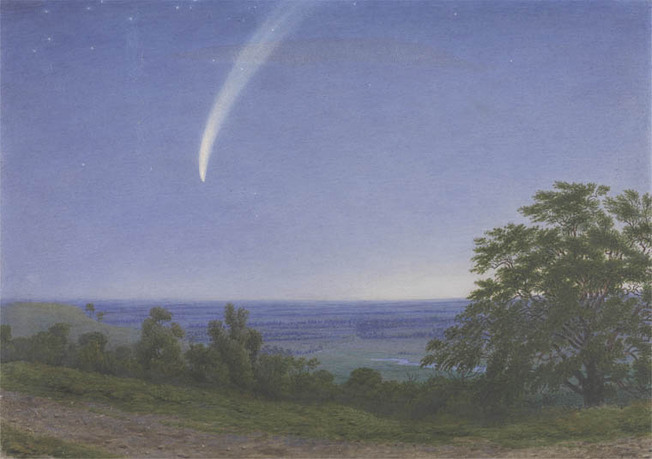
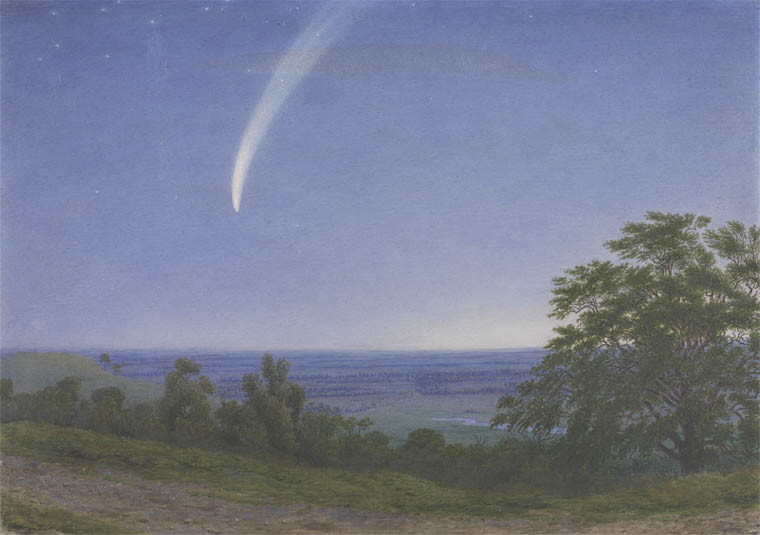
William Turner of Oxford, “Donati’s Comet,” 1859. Watercolor and gouache over graphite on moderately thick, slightly textured, cream wove paper, 10 1/8 x 14 3/8 in. Courtesy Yale Center for British Art, New Haven
This project culminates in the publication of a collaboratively authored book titled Wait a Minute: How the History of the Earth Impinges on Architecture, which continues the unfinished manuscript of architectural historian Kurt W. Forster. The book interlaces fragments of Forster’s manuscript with newly commissioned essays by a small, multidisciplinary group of writers who shared an interest in geology. Built around an introduction that explains the project’s premise and method, the book follows Forster’s recurring question: how does the deep history of the earth bear on human perception, memory, and making, and why does this pressure repeatedly bring architecture into view?
Kurt W. Forster (1935–2024) was an internationally renowned architectural historian who earned his PhD from the University of Zurich and held leading academic and institutional positions across Europe and North America. He taught at Stanford University; Massachusetts Institute of Technology; University of California, Berkeley; ETH Zurich; and Princeton University. He also served as Gropius Professor at Bauhaus University Weimar and Scully Visiting Professor at Yale University. In 1984 he became founding director of the Getty Center for the History of Art and the Humanities (now the Getty Research Institute), where he established its acclaimed library, research programs, and exhibitions. He later headed the gta Institute at ETH Zurich and directed the Canadian Centre for Architecture. Forster published widely on figures from Andrea Palladio to Frank Gehry, shaping discourse across early modern and contemporary architecture alike, and curated major exhibitions, including the 9th International Architecture Exhibition–La Biennale de Venezia. He received numerous honors, including the Meret Oppenheim Prize and the Schinkel-Preis.
Nicholas Adams is professor emeritus of the history of architecture at Vassar College, where he held the Mary Conover Mellon Chair. He is the recipient of fellowships from the Center for Advanced Study in the Visual Arts, National Gallery of Art; Institute for Advanced Study, Princeton University; American Academy in Rome; and the National Endowment for the Humanities. He has published books on the architect Gordon Bunshaft (2019); on Gunnar Asplund and the city of Gothenburg, Sweden (2014); and the first independently authored book about Skidmore Owings & Merrill (2007); as well as studies of the architectural drawings of Antonio da Sangallo (1994, 2000); sixteenth century military architecture in Siena, Italy, with Simon Pepper (1986). He has curated exhibitions on the utopian socialist Robert Owen (Vassar, 2013), the Vassar collection of architectural books (2015, 2026), and with Francis Kowsky, an exhibition of architectural books in the Erie County Library, Buffalo, NY (2017). An exhibition on the fountain pen Hastil opens at Associazione per il Disegno Industriale (Milan) in 2026.
Tairan An is lecturer and postdoc at the Institute for the History and Theory of Architecture (gta), ETH Zurich. He received a PhD in history and theory of architecture at Princeton University (2024), he holds a bachelor’s degree in urban planning from Peking University, and an MDes in history and philosophy of design with distinction from Harvard University Graduate School of Design. For his book manuscript Observatory Effects: The Incidental Artifactuality of the Frontier Sciences in Italy, c. 1840–1890, he is the recipient of the 2026 Alan Reinerman Prize for Best Unpublished Manuscript by the Society for Italian Historical Studies, an affiliate society of the American Historical Association. He was project manager and research associate for the exhibition Amid the Elements (curated by Sylvia Lavin) at the 19th International Architecture Exhibition–La Biennale di Venezia (2025).
Philip Ursprung is professor of the history of art and architecture at ETH Zurich. He taught at Universität der Künste Berlin, Columbia University, Cornell University, and the University of Zurich. He is author of Die Kunst der Gegenwart (Beck, 2010); Allan Kaprow, Robert Smithson, and the Limits to Art (University of California Press, 2013); Joseph Beuys: Kunst Kapital Revolution (Beck, 2021); Architektur der Gegenwart (Beck, 2025); and Values and Surfaces: Art, Economy, Architecture (gta Verlag, 2025). He is editor of Herzog & de Meuron: Natural History (Canadian Centre for Architecture, 2002) and coeditor of Gordon Matta-Clark: An Archival Sourcebook (University of California Press, 2022). With the exhibition Neighbours he represented Switzerland together with Karin Sander at the 18th International Architecture Exhibition–La Biennale de Venezia (2023).
Giuliana Bruno is Emmet Blakeney Gleason Professor of Visual and Environmental Studies at Harvard University. She has published seven books and over one hundred essays on visual arts, architecture, and media. Her latest book is Atmospheres of Projection: Environmentality in Art and Screen Media (Chicago, 2022). Atlas of Emotion: Journeys in Art, Architecture and Film (Verso, 2002) has provided new directions for visual studies and won the Kraszna-Krausz prize for best Moving Image Book. Her other books include Streetwalking on a Ruined Map (Princeton, 1993), winner of the Society for Cinema and Media Studies book award; Public Intimacy: Architecture and the Visual Arts (MIT, 2007), and Surface: Matters of Aesthetics, Materiality, and Media (Chicago, 2014). Bruno has written on art, among others, for the Guggenheim Museum, the Venice Biennale, the Whitney Museum, and the Museum of Modern Art (MoMA).
Mark Jarzombek is professor of the history and theory of architecture at Massachusetts Institute of Technology. An architectural historian, educator, and designer, Jarzombek has built a body of work that spans global history, contemporary criticism, and the theoretical foundations of the discipline. His scholarship engages topics ranging from early modernism and urban destruction to philosophy and the global circulation of ideas. He is a cofounder of the Global Architecture History Teaching Collaborative (GAHTC), and together with Vikramāditya Prakash and Francis D.K. Ching, a coauthor of the textbook A Global History of Architecture (Wiley Press, 2006). His most recent books are The Long Millennium: Affluence, Architecture and its Dark Matter Economy (Routledge, 2023) and Architecture Constructed: Notes on a Discipline (Bloosmbury, 2023). His other books include The Digital Stockholm Syndrome in the Post-Ontological Age (University of Minnesota Press, 2016) and Architecture of First Societies: A Global Perspective (Wiley Press, 2013).
Jan Röhnert, born 1976 in Thuringia/Germany. PhD from Friedrich Schiller University Jena 2006 on Poetry and Film (Cendrars, Ashbery, Brinkmann); habilitation 2013 at TU Braunschweig in comparative literature for a study on autobiography and war (Goethe, Heine, Fontane, Benn, Jünger, Handke). Teaching Literature at Braunschweig Technical University since 2011. Besides academic research, current works include nature writing (Vom Gehen im Karst, Berlin: Matthes & Seitz 2021; Karstwärts. Erfurt: kul-ja 2024; Wildnisarbeit. Schreiben, Tun und Nature Writing. Wien: Arco 2025), poetry (Erdtagzeit. Frankfurt/M.: Edition Faust 2023; Zwischenbaumstätten. Leipzig: Poetenladen 2027) and translations of Ron Padgett’s poetry (Die schönsten Streichhölzer der Welt. Gedichte englisch–deutsch. Mainz: DVB 2017; Hier und dort & dort und hier. A New York poet’s travels to Western Europe. Mainz: DVB 2023). For his literary work, he is the recipient of the Johann Gottfried Seume Award in 2025 and the Wilhelm Lehmann Award in 2026.
Marina Warner is an award-winning novelist, short story writer, historian, and mythographer, who works across genres and cultures exploring myths and stories. Her studies of religion, mythology, and fairy tales include Alone of All Her Sex: The Myth and the Cult of the Virgin Mary, From the Beast to the Blonde, Stranger Magic (National Book Critics Circle Award for Literary Criticism; Truman Capote Award), and Sanctuary: Ways of Telling, Ways of Dwelling. A Fellow of the British Academy, Warner is also a distinguished fellow of All Souls College, Oxford, and professor of english and creative writing at Birkbeck College, University of London. In 2015 she was awarded the Holberg Prize and in 2017–21 she served as president of the Royal Society of Literature, the first woman to hold the post. She was made Dame Commander of the Order of the British Empire in 2015 and Companion of Honour in 2023.
Lydia Xynogala works across buildings, environments, and texts, exploring the intersections of architecture, geology, and cultures of care. Xynogala is a postdoctoral lecturer at USI Mendrisio and HfG Karlsruhe, her research on Greek mineral spring baths was nominated for the ETH Medal and is the subject of her forthcoming book by Park Books. Her practice is recognized in the Greek Architecture Awards and the European Prize for Urban Public Space. Supported by the Onassis Foundation and the New York Foundation for the Arts, her work has been exhibited at Storefront NY, gta exhibitions, ZAZ Bellerive and Mendrisio. Her essays appear in e-flux architecture, Log, Future Anterior and MIT Thresholds; she also serves as an editor for Kyklada Press. Lydia holds degrees from Princeton, Cooper Union and the Bartlett, and taught at Columbia GSAPP, The Cooper Union and RPI. She founded the Zurich-based non-profit Friends of the 750 Mineral Springs of Greece.
ETH Zurich's Institute for the History and Theory of Architecture (gta) aims to address architecture in all its historical depth and ideological breadth, systematically reflecting upon it to inform contemporary design. The institute integrates empirical scholarship with critical theory, bridging the gap between historical research and present-day architectural practice.