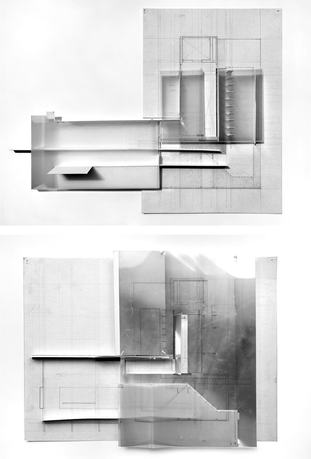
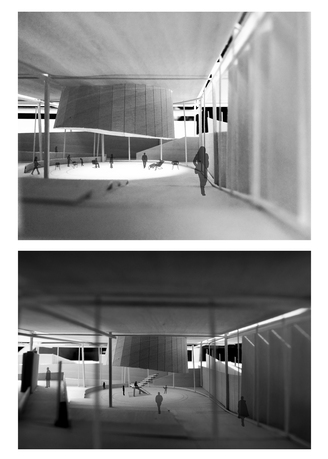
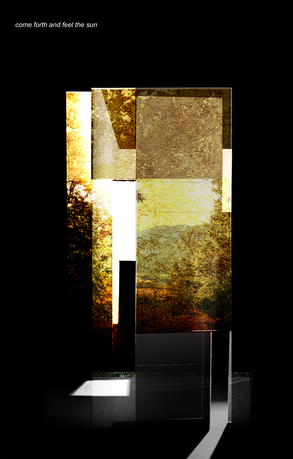
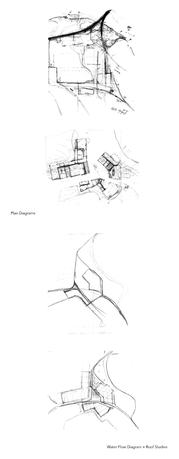
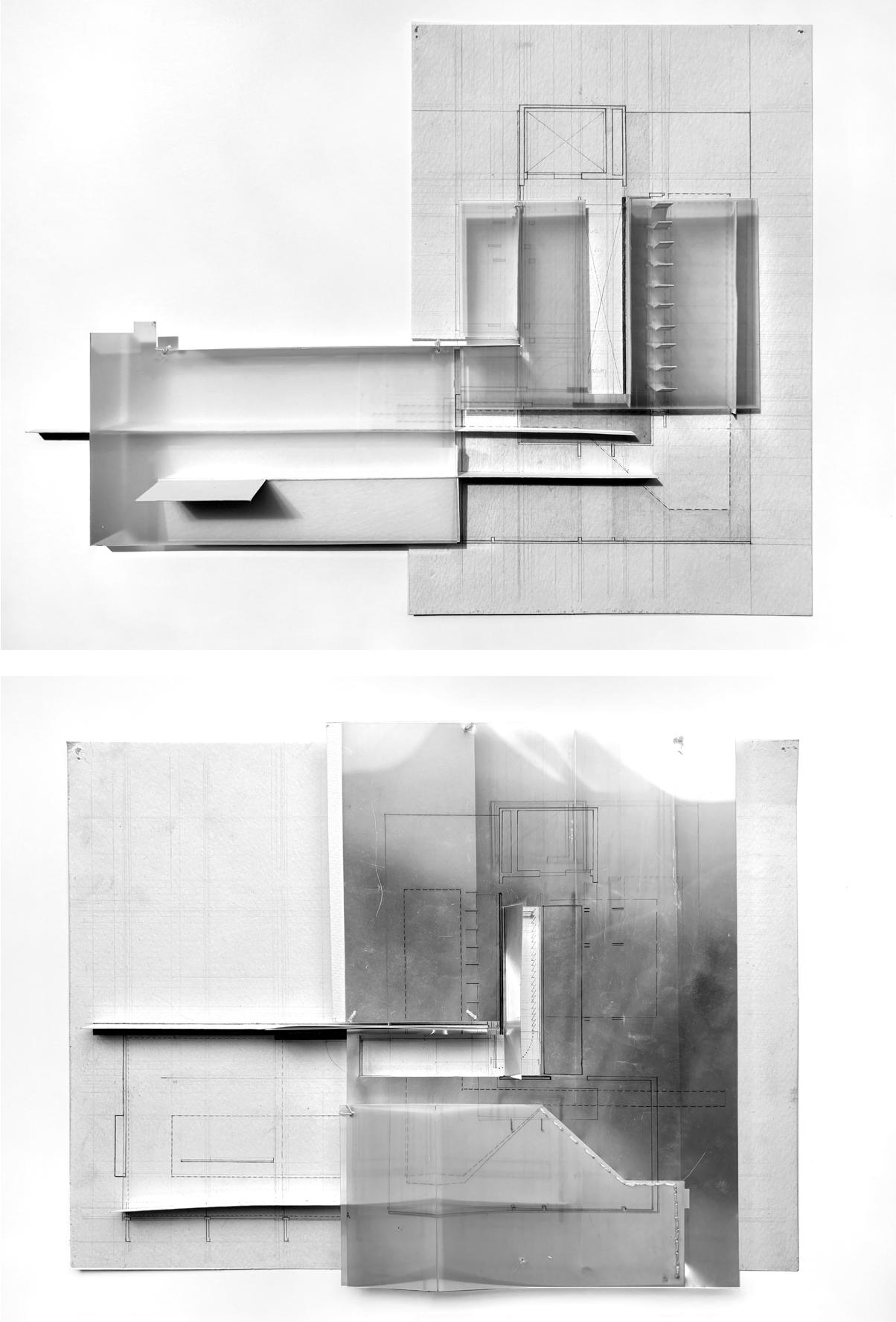
Lyndsey Weismann, “Reconstructions of the Primitive Hut,” 2025. Photograph of three-dimensional bristol collages, 5 x 7 in. From “VORKURS,” Vol. X: “INTERSTICE.” Courtesy University of Florida, School of Architecture, Gainesville
VORKURS XI: Afterimage is the current edition of the University of Florida Graduate School of Architecture’s student-initiated publication. VORKURS began in 2015 as an ode to Josef Albers’s Bauhaus Foundation course and features the craft, storytelling, and invention of acclaimed theorists and architects, including Juhani Pallasmaa and Todd Williams Billie Tsien Architects. Continuing the legacy of VORKURS into its second decade of production, Afterimage turns inward to examine the residual impressions that shape design thought and practice. Afterimage considers how knowledge is inherited, layered, and carried forward—often unconsciously—through students, teachers, and professionals. We design not from a blank slate but from accumulated traces of the past. Though these influences may be subtle, they contour decisions, values, and ambitions. VORKURS XI: Afterimage confronts intellectual and creative ghosts to define the edges of what lingers, and to reinterpret the imprints that inform who we are becoming as architects.
Riley Barker is one of the research editors of VORKURS XI. He was born in central Florida and grew up in Casselberry, just outside of Orlando. Barker graduated cum laude in 2025 from the University of Florida (UF) with a bachelor’s in design. Throughout his undergraduate studies, Barker worked as both an undergraduate teaching assistant and an undergraduate research assistant for the Florida Institute of Built Environment Resiliency (FIBER). Barker is now an MArch candidate at UF interested in reconnecting people with their local environments and restoring the “spirits in everyday places.” During his master's program, Barker worked as a graduate teaching assistant for first-semester architecture students and has served as a guest critic on lower division reviews.
Albert Condori is one of the production editors of VORKURS XI. Born in Cochabamba, Bolivia, he moved to Miami, Florida in 2011 and came to consider South Florida home. He graduated magna cum laude from the University of Florida School of Architecture in 2025 with a bachelor’s in design. During his undergraduate studies, he developed a strong interest in sustainable building practices and human-driven design. Condori is pursuing an MArch at the University of Florida along with a certificate in sustainable architecture, to expand his focus on resilience, adaptive design, and advanced building technologies. His thesis challenges the current static, cost-driven affordable housing models by developing a dynamic modular housing framework that integrates kinetic systems and computational design to enhance spatial flexibility and quality of life within compact affordable housing.
Maria Grazia Cocco is one of the research editors of VORKURS XI. Born in Sardinia, Italy, she moved to southwest Florida when she was nine years old. In 2024, she graduated magna cum laude from the University of Florida with a bachelor’s in design and a minor in Italian studies. During her undergraduate studies, Cocco was a contributor on the thirtieth edition of Architrave, an undergraduate architecture publication, and served as a teaching assistant for an undergraduate design studio. Alongside her MArch studies she is pursuing a certificate in historic preservation to expand her interests in adaptive reuse and projects in historic settings. Her thesis explores critical regionalist practices within the context of Sardinia’s complex history.
Andrew Haines is copyeditor of VORKURS XI. He was born in Mt. Vernon, Washington, later moving to Raleigh, North Carolina; London, England; Tokyo, Japan; and Jacksonville, Florida before attending the University of Florida School of Architecture, where he earned a bachelor of design in architecture. Haines is an March candidate at the University of Florida and serves as a graduate teaching assistant in undergraduate architecture courses. Haines is interested in the emotive nature of architecture and the vast importance of narrative-based design in individual projects as well as urban landscapes.
Charlie Hailey is an architect, writer, and professor. A Guggenheim Fellow and Fulbright Scholar, he is the author of six books, including The Porch: Meditations on the Edge of Nature (University of Chicago Press, 2021); Camps: A Guide to 21st Century Space (MIT Press, 2009); and Slab City: Dispatches from the Last Free Place (MIT, 2018). Hailey teaches design/build, studio, and theory at the University of Florida, where he was recently named Teacher/Scholar of the Year. In Spring 2021, he was Mentoring Artist-in-Residence at the Atlantic Center for the Arts (ACA).
Sidney Ruedas is the executive editor of VORKURS XI. A Floridia native from Orlando, she graduated cum laude from the University of Florida (UF) in 2024 with a bachelor’s in design and minors in sustainability within the built environment and urban and regional planning. During her undergraduate studies, Ruedas served as an undergraduate teaching assistant for studio courses and as a member of the UF Preservation of Historic Sites and Sustainability Joint Student/Faculty Committee. After her undergraduate studies, she worked in New York as a design professional with Walters-Storyk Design Group, an architectural and acoustics consulting firm. Ruedas is now an MArch candidate and graduate teaching assistant for integrated technologies courses and exploring a thesis topic of multispecies design along evolving coastlines.
Kadir Salas Fuentes is cochair of marketing for VORKURS XI. Born in Camagüey, Cuba, he moved to the United States in 2010 to pursue educational opportunities. He graduated summa cum laude with a bachelor’s in design from the University of Florida and is pursuing an MArch. Salas Fuentes is interested in community-based architecture that employs sustainable materials to create affordable structures in underserved countries, an interest informed by his early upbringing in Cuba.
Christopher Santiago is cochair of marketing for VORKURS XI. Born in Orlando, Florida, he has come to call both Orlando and New York City his homes. Santiago graduated cum laude from the University of Florida in 2025 with a bachelor’s in design and is pursuing an MArch degree at the University of Florida. He has a strong interest in designing spaces that activate the public realm and spaces that support social interaction across a range of scales.
Logan M. Weaver is the finance editor of VORKURS XI. He was born in Lake Wales, Florida, and attended the University of Florida School of Architecture (UF SoA), graduating with a bachelor’s in design. During his undergraduate studies he assisted in studio teaching and helped preserve foundational curriculum documents. He is an MArch candidate at UF SoA, where he assists with first-year studio instruction. His interests include the Bauhaus legacy of curricula at UF and the telescopic realities of the new city.
Nichole Wiedemann is an associate professor and the director of the Professional Residency Program at The University of Texas at Austin. She teaches design studios, drawing courses, theory seminars, and study abroad programs. From 2008 to 2013, she was the associate dean for undergraduate programs in the School of Architecture. A registered architect, Wiedemann maintains a small independent practice with projects in Texas, Georgia, and Florida. Her work, independent and collaborative, has been exhibited nationally and internationally and published in the Journal of Architectural Education, On Site, Progressive Architecture, and other publications.
VORKURS, founded in August 2015, is the publication for the University of Florida's Graduate School of Architecture. Developed as an ode to the Bauhaus foundation course of the same name, it aims to present the ideas of the school’s graduate students and faculty through three different lenses—pedagogy, the transition from academia to practice, and the future of the profession—in order to present the University of Florida’s unique voice to the larger discourse of architecture.