Anthony Pateras
Lampo Performance Series
Jun 08, 2019
(8pm)
Performance
RSVP required
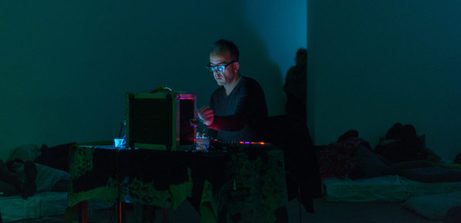
This Ain’t My First Rodeo explores the psychoacoustic interactions between two synthesizers in quad sound, with additional material generated and mutated by 1/4-inch tape delay. Anthony Pateras’ new project wraps listeners in an extraordinary sensory experience of musical illusions.
The title itself also may be deceptive. Pateras is no novice, after more than 20 years on the scene. But don’t read the work as any kind of boast. Instead, the rodeo reference is akin to the turbulent self-reinvention he went through when starting this piece, which he reveals last happened when he wrote "Blood Stretched Out" for Lampo in 2014.
Pateras finds inspiration in the words of poet Adrienne Rich: “All new learning looks at first like chaos.”
“Music is so mysterious. When you find something that works, you can be very tempted to keep doing the same thing,” says the Australian composer.
“I tend to get bored and look for a new take or approach. It feels very chaotic, but I remind myself that’s what you always have to go through. This seems to be the ideal state for a musician to do a good job—terrified curiosity.”
Anthony Pateras is a composer and performer whose current work focuses on electroacoustic orchestration, temporal hallucination and sound phenomena. Pateras has created over 75 works, receiving performances from the Los Angeles Philharmonic, Australian Chamber Orchestra and BBC Symphony; commissions from the GRM, Slagwerk Den Haag and Südwestrundfunk Baden-Baden; residencies from ZKM, Akademie Schloss Solitude and La Becque; and fellowships from Creative Victoria, and the Ian Potter and Sydney Myer Foundations. He has released over 40 albums including collaborations with Mike Patton, Stephen O’Malley and Valerio Tricoli. Aside from solo concerts, he currently performs with eRikm, Jérôme Noetinger and Erkki Veltheim.
Pateras made his Chicago debut for Lampo and the Graham Foundation in May 2011.
Since 2010 the Graham Foundation has supported and partnered with Lampo to produce this performance series held at the Madlener House. Lampo, founded in 1997, is a non-profit organization for experimental music and intermedia projects.
Image: Courtesy of the artist.

Spirit of the Waves: Opening Reception
Nelly Agassi
May 23, 2019
(6pm)
Opening Reception
Please RSVP
Join us for a reception with artist Nelly Agassi to celebrate the opening of her new exhibition Spirit of the Waves.
Through a newly commissioned body of work, including a large-scale textile installation, intricate embroideries, works on paper, sculptures, and a performance, Nelly Agassi conjures historical and imagined narratives from the architectural details of the Graham Foundation’s Madlener House. Built in 1901–02 for Albert F. and Elsa S. Madlener, the house was originally designed by architect Richard E. Schmidt, with designer Hugh M. G. Garden, and then renovated in the 1960s by architect Daniel Brenner to transform it into the Foundation’s headquarters. The culmination of Agassi’s 2019 Graham Foundation Fellowship, this exhibition explores erasure, preservation, identity, and architecture’s capacity to change.
Chicago-based artist Nelly Agassi (b.1973, Israel) received her MFA from Chelsea College and her BFA from Central St. Martins, both in London. Her work has been shown internationally at institutions and galleries such as The Arts Club of Chicago, Aspect Ratio, Hyde Park Art Center, The Israel Museum, Poor Farm, Tate Modern, Tel Aviv Museum of Art, La Triennale di Milano, and Zacheta Warsaw. Agassi is a cofounder of the nonprofit organization Fieldwork Collaborative Projects and a 2019 Graham Foundation Fellow. She is represented by Dvir Gallery and Foksal Gallery.
Agassi worked with Hand and Lock embroidery house in London and The Weaving Mill in Chicago to produce works in the exhibition.
Hand & Lock are London’s premier embroidery house providing embellishment services to the Royal Family, top European design houses, the Royal Armed Forces, Savile Row and members of the public.
The Weaving Mill is an experimental weaving studio in Chicago’s Humboldt Park that blends design, fine art, textile education, and research-based practice.
Spirit of the Waves is commissioned by the Graham Foundation and organized by director Sarah Herda and Ellen Alderman, deputy director of exhibitions and public programs, with James Pike and Ava Barrett. Special thanks to Lori Hanna Boyer and Christopher Rosenberg, Department of Architecture and Design, The Art Institute of Chicago; Jaime Fuentes; Chandra Goldsmith Gray; Scott Heron and Jessica Jane, Hand & Lock; Sharon Hoyer, High Concept Labs; Duncan Jackson and Simon Kristak, Billings Jackson Design; Jennifer Keats, Service Bureau, School of the Art Institute of Chicago; Lauren Mack; Peter Maunu; Ryan Packard; Nathaniel Parks, Ryerson & Burnham Libraries, The Art Institute of Chicago; Emily Frances Winter, The Weaving Mill; and the Graham Foundation staff: Vidisha Aggarwal, Alexandra Drexelius, Carolyn Kelly, Ron Konow, Junxi Lu, and Alexandra Small.
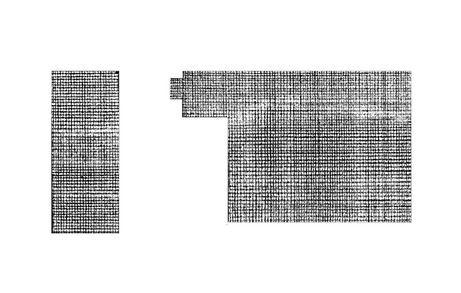
Image: Nelly Agassi, Plot, 2019. Digital manipulation of the 1967 Madlener House plans drawn for the Historic American Buildings Survey. Courtesy of the artist and Graham Foundation, Chicago.
For more information on the exhibition, Spirit of the Waves, click here.
And then when I went to Chicago, that's when I had these outer space experiences and went to the other planets.
Anne Dessing
May 02, 2019
(7pm)
Talk
Please RSVP
As the Douglas A. Garofalo Fellow from the University of Illinois at Chicago (UIC) School of Architecture, Anne Dessing has researched architectural elements that divide space, such as walls, doors, windows, columns, fences, arches, and gates.
Through a pictorial essay of architectural elements and surfaces from Detroit, St. Louis, and Chicago, Dessing shares her observations as stories of surreal situations in the Midwest. This talk supplements the exhibition of the same name currently on view at the UIC School of Architecture until May 10.
Anne Dessing is an architect based in Amsterdam. Since graduating from the Amsterdam Academy of Architecture in 2012, she has been awarded grants from the Creative Industries Fund NL and the Prince Bernhard Cultural Foundation. Her practice, Studio Anne Dessing, operates at the intersection of art and architecture, and she researches architecture through exhibitions, installations, drawings, models, interiors, and (temporary) buildings. Dessing has taught at the Academy of Architecture in Amsterdam and Rotterdam, the Rietveld Academy, and the Chair of Interiors Buildings Cities at TU Delft.
About the Douglas A. Garofalo Fellowship
Named in honor of architect and educator Doug Garofalo (1958–2011), this nine-month teaching fellowship—supported with a grant from the Graham Foundation—provides emerging designers the opportunity to teach studio and seminar courses in the undergraduate and graduate programs and conduct independent design research. The fellowship also includes a public lecture at the Graham Foundation and an exhibition at the UIC School of Architecture. To learn more about the fellowship, click here.
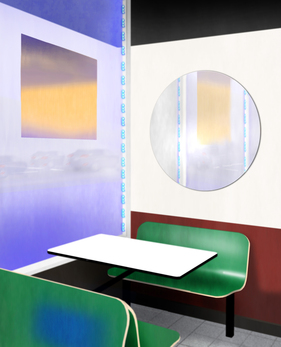
Image: Anne Dessing, Harold’s Chicken Shack W 87th St, rendering, 2019
James Hoff
Lampo Performance Series
Apr 27, 2019
(8pm)
Performance
RSVP required
James Hoff’s work often relies on misusing technology as a generative act.
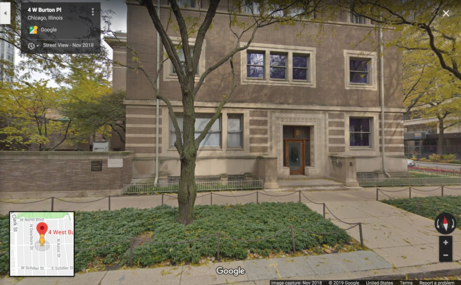
For Lampo and the Graham Foundation, he presents a site-specific version of his most recent audiovisual project HOBO UFO, which uses a custom hack of Google Maps’ Street View to make the platform sound reactive. Hoff’s performance takes place physically and virtually in Chicago, starting at Madlener House and then moving beyond, driven by the real-time music the artist creates from pilfered radio frequencies that transmit GPS and other data streams.
James Hoff (b.1975, Fort Wayne, Ind.) works in a variety of media, including painting, sound, writing, and performance. In recent years, his interests have focused on language and media systems at the intersection of developing technologies and traditional artistic genre forms. He has created paintings and music using computer viruses and developed several bodies of work that examine how the language of network communication has changed our contemporary notions of landscape and nature.
Hoff is also one of the founders of Primary Information, a nonprofit arts organization devoted to publishing artists’ books and art historical documents. He has two releases forthcoming on PAN in 2019, HOBO UFO (Cherynobyl) and an LP of works for French horn and tuba.
James Hoff first performed for Lampo in December 2015.
Since 2010 the Graham Foundation has supported and partnered with Lampo to produce this performance series held at the Madlener House. Lampo, founded in 1997, is a non-profit organization for experimental music and intermedia projects.
Artist Talk: Hoff describes his studio practice as a painter and sound artist, including his reliance on self-distributing and language-based systems, which for him are both metaphors for creation and generative tools. He elaborates on his HOBO UFO project and discusses an “ambient capitalism” and its relationship to the work and the exclusion zone around Chernobyl and Pripyat, Ukraine. Lampo Annex, Monadnock Building, 53 W. Jackson Blvd. #1656. Friday, April 26, 6pm. RSVP for the talk HERE
Possible Mediums
Kelly Bair, Kristy Balliet, Adam Fure, and Kyle Miller
Apr 25, 2019
(6pm)
Panel Discussion
Please RSVP
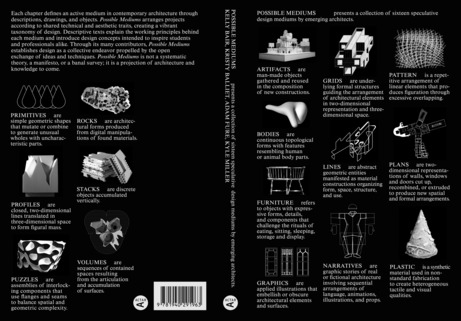
Join us for a panel discussion to launch the recently published Graham funded book Possible Mediums. The editors Kelly Bair, Kristy Balliet, Adam Fure, and Kyle Miller will present the Possible Mediums book and will be joined in discussion by Zoë Ryan.
Possible Mediums presents a collection of sixteen speculative design mediums by emerging architects. Each chapter defines an active medium in contemporary architecture through descriptions, drawings, and objects. Possible Mediums arranges projects according to shared technical and aesthetic traits, creating a vibrant taxonomy of design. Descriptive texts explain the working principles behind each medium and introduce design concepts intended to inspire students and professionals alike. Through its many contributors, Possible Mediums establishes design as a collective endeavor propelled by the open exchange of ideas and techniques. Possible Mediums is not a systematic theory, a manifesto, or a banal survey; it is a projection of architecture and knowledge to come.
Kelly Bair is Partner of BairBalliet, Director of Graduate Studies and Associate Professor at University of Illinois at Chicago School of Architecture.
Kristy Balliet is Partner of BairBalliet and Faculty at Southern California Institute of Architecture.
Adam Fure is Principal of T+E+A+M and Assistant Professor at University of Michigan Taubman College of Architecture and Urban Planning.
Kyle Miller is an Assistant Professor at Syracuse University School of Architecture.
Zoë Ryan is the John H. Bryan Chair and Curator of Architecture and Design at the Art Institute of Chicago. A curator and author, her projects focus on exploring the impact of architecture and design on society.
Related Graham supported projects:
2018 grant to Kelly Bair, Kristy Balliet, Adam Fure, and Kyle Miller for the publication Possible Mediums
Image: Cover of Possible Mediums, 2018.

 PREVIOUS POSTS