LoVid
Lampo Performance Series
Sep 16, 2017
(8pm)
Performance
Reservations are required
LoVid presents Mesh Extenders, a group of interconnected compositions made for their handmade analog synthesizers along with video—new work that constructs landscapes between virtuality, abstraction, and documentation of daily life.
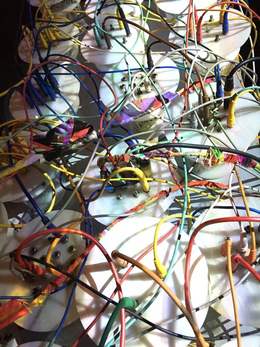
The art duo’s A/V performances are live, immersive, visceral, audiovisual noise. Their synthesizers are designed to continue the legacy of artist-made tools. LoVid’s approach to instrument building is an exploration of the relationship between craft and engineering, embracing and integrating fragilities of analog systems into the instruments’ design, and audiovisual compositions. Aesthetically, the instruments are sculptural combinations of circuits, wires, and textiles. Combining material and media sheds light on handmade DIY technological tools that expand on the relationship between the human body and technological development as part of the artists’ practice.
Tali Hinkis (b.1974, Jerusalem, Israel) and Kyle Lapidus (b.1975, New York, N.Y.) have worked together as LoVid since 2001. Their work includes immersive installations, sculptural synthesizers, single channel videos, textile, participatory projects, mobile media cinema, works on paper, and A/V performance. Projects have been presented at ISSUE Project Room, New York; The Jewish Museum, New York; The Neuberger Museum, Purchase, New York; The New Museum, New York CAM Raleigh, North Carolina; Hors Pistes Tokyo Daejeon Museum of Art, Korea; Netherlands Media Art Institute; and ICA, London; among many others. LoVid has performed and presented works at The Kitchen, MoMA, PS1 and The Museum of the Moving Image, all in New York; Lampo, Chicago, International Film Festival Rotterdam, The Netherlands; CCA (Israel) and FACT (Liverpool). They have received support from several organizations and foundations. LoVid’s video works are distributed through Electronic Arts Intermix.
LoVid last appeared at Lampo in December 2010. They premiered C/O/L/O/R/G/B, performing with a new synthesizer color wheel. In Becoming One.2, LoVid invited guests to contribute body signals that were amplified by the duo’s circuit tacos.
Since 2010 the Graham Foundation has supported and partnered with Lampo to produce this performance series held at the Madlener House. Lampo, founded in 1997, is a non-profit organization for experimental music and intermedia projects. Additional support is provided by mediaThe foundation inc.; organized in cooperation with the School of the Art Institute of Chicago, Department of Art and Technology Studies and Department of Performance.
Related Graham Foundation supported projects:
2013 New Media Grant to LoVid for iParade (Chicago)
2016 New Media Grant to LoVid for iParade (Chicago)

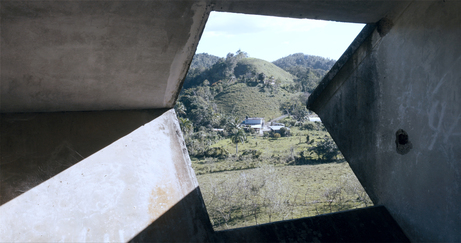
David Hartt, still from “in the forest,” 2017. 4K Digital Video File, color, sound; 20 min. Courtesy of Corbett vs. Dempsey and commissioned by the Graham Foundation for Advanced Studies in the Fine Arts.
'in the forest' Opening Reception
David Hartt
Sep 14, 2017
(6pm)
Opening Reception
Graham Foundation
Please RSVP
Join us for a reception to celebrate the opening of in the forest, an immersive installation by artist David Hartt that revisits architect Moshe Safdie’s unfinished 1968 Habitat Puerto Rico project through a contemporary lens. Consisting of a newly commissioned film, a suite of photographs, and a series of sculptures, the exhibition continues Hartt’s investigation into the relationship between ideology, architecture, and the environment.
6-8:00 p.m. Opening Reception
6:00 p.m. Comments by David Hartt with Graham Foundation director Sarah Herda
For more information on the exhibition, in the forest, click here.
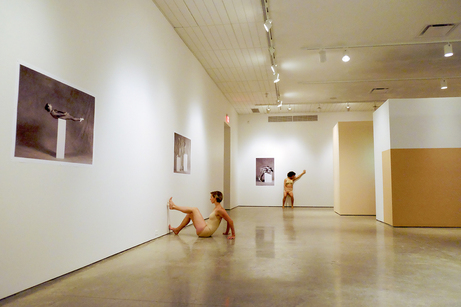
"Still Move," performance stills taken at Southern Alberta Art Gallery, Lethbridge, Canada, 2015. Courtesy of the artist and Monique Meloche Gallery, Chicago. Photo: Rod Leland Photography
Lost Bodies and Still Move
Brendan Fernandes
May 25, 2017
(6pm)
Book Launch
Please RSVP
Join us for the Chicago launch of Lost Bodies and Still Move, two new monographs on the work of artist Brendan Fernandes. David Getsy and Zach Stafford will join Fernandes in a conversation about his recent work. A book signing and reception will follow the discussion.
In his multimedia practice, Brendan Fernandes addresses a wide range of questions surrounding identity and expression, including the concept of queer bodies, the history of ballet as a cultural signifier—particularly in juxtaposition to African modes of visual and ritual art—and, more recently, the dance floor as a sacred space of freedom. Lost Bodies (Agnes Etherton Art Centre, Queen’s University, ON, 2016) and Still Move (Black Dog Press, London, 2017) explore these themes in depth.
Brendan Fernandes (b. 1979, Nairobi, Kenya, lives and works in Chicago) is a Canadian artist of Kenyan and Indian descent. He completed the Independent Study Program of the Whitney Museum of American Art (2007) and earned his MFA from the University of Western Ontario (2005) and his BFA from York University in Canada (2002). Fernandes has exhibited widely domestically and abroad, including exhibitions at the Solomon R. Guggenheim Museum, New York; Museum of Modern Art, New York; Museum of Art and Design, New York; Musée d'art contemporain de Montréal; The National Gallery of Canada, Ontario; The Brooklyn Museum, New York; The Studio Museum in Harlem, New York; Mass MoCA, North Adams, MA: The Andy Warhol Museum, Pittsburgh, PA; Deutsche Guggenheim, Berlin; Bergen Kunsthall, Norway; Stedelijk Museum, Amsterdam; The Sculpture Center, New York; The Quebec City Biennial; the Third Guangzhou Triennial in China; and Monique Meloche Gallery, Chicago.
Upcoming projects include a performance of Free Fall at The Getty, Los Angeles (June); a residency at Recess, New York (July); and a solo exhibition at Aljira Center for Contemporary Art, Newark, NJ(fall 2017). He is currently Artist in Residence and Faculty at Northwestern University in the Department of Art Theory and Practice, and is represented by Monique Meloche Gallery, Chicago.
David J. Getsy is the Goldabelle McComb Finn Distinguished Professor of Art History at the School of the Art Institute of Chicago. He has published seven books, most recently Abstract Bodies: Sixties Sculpture in the Expanded Field of Gender (Yale University Press, 2015) and the anthology of artists’ writings, Queer (MIT Press, 2016), which is a 2017 Lambda Literary Awards Finalist. He writes about histories of art and performance with an emphasis on queer and transgender topics and methods in modern and contemporary art, and his current projects pursue archive-based recoveries of forgotten queer and genderqueer performance practices in late-twentieth-century America.
Zach Stafford is the editor at large of Out Magazine and a contributing writer for The Guardian where he covers justice, violence and social issues. He regularly provides commentary on radio, podcasts, and has appeared on the BBC, CNN, and The Daily Show with Trevor Noah. Zach is also the co-editor of the bestselling book Boys, An Anthology (2013), and is currently touring his photo-essay project, When Dogs Heal, which explores the lives of HIV+ people and the pets that saved their lives.
Phill Niblock, "Meudrone1," 2013
Phill Niblock
Lampo Performance Series
May 20, 2017
(8pm)
Performance
Please RSVP
Join us for the debut of recent work by the great minimalist composer Phill Niblock in his first Chicago performance in more than eight years. Niblock constructs 24-track digitally-processed, monolithic, microtonal drones, and describes the intention of his music as “produce[ing] something without rhythm or melody, by using many microtones that cause movements very, very slowly.”
The two-hour program in the Graham Ballroom includes the following recorded works: FeedCorn Ear (2012) with Arne Deforce, cello; Bag (2014) with David Watson, bagpipes; Praised Fan (2016) with Dafne Vicente-Sandoval, bassoon; Ronet (2014) with Neil Leonord, tenor saxophone; V&LSG (2015) with Lore Lixenberg, voice, and Guy De Bièvre, lap steel guitar; and Vlada BC (2013) with Elisabeth Smalt, viola d’amore. Cellist Fred Lonberg-Holm joins Niblock to play live on FeedCorn Ear.
In keeping with other Niblock performances, his films and videos accompany this presentation. Meudrone1 (2013), Agosto (2014), DH *Sand-Water (2014), Vain4 (2015), and Meudrone2 (2014), all works that include time-stretched and close-up studies of nature play as his new works play.
Niblock first performed at Lampo in March 2000, screening six 16mm films from the 1960s including The Magic Sun in addition to presenting his music. Additional Lampo performances followed in May 2001, February 2005, and December 2008, of various works and films from The Movement of People Working.
Phill Niblock (b.1933, Anderson, Ind.) is an intermedia artist using music, film, photography, video, and computers. He has presented his work around the world since the mid-1960s and has received grants from the Guggenheim Foundation, the New York State Council on the Arts, the National Endowment for the Arts, the Creative Artists Public Service Program, the City University of New York Research Foundation, and the Foundation for the Contemporary Performance Arts. Niblock has been a member of the Experimental Intermedia Foundation in New York since 1968 and now serves as director following his appointment in 1985.
Since 2010 the Graham Foundation has supported and partnered with Lampo to produce this performance series held at the Madlener House. Lampo, founded in 1997, is a non-profit organization for experimental music and intermedia projects.
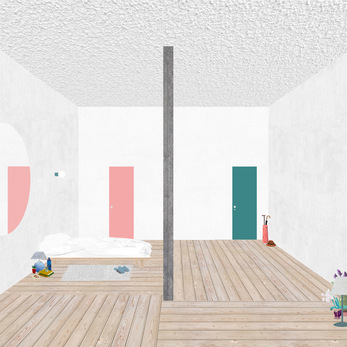
fala atelier, São Brás apartment, 2017. © fala atelier
Portraits
fala atelier
May 04, 2017
(6pm)
Talk
Please RSVP
Filipe Magalhães, architect and co-founder of the architecture firm fala atelier, presents a talk about the firm's practice and their participation in the Graham Foundation’s current exhibition, Spaces without drama or surface is an illusion, but so is depth. Join us as fala atelier explores perspectives on collage and the allusion to portraiture in their work. The conversation begins with the assertion that each portrait tells a short story and continues with explorations of what is feasible within the medium.
fala atelier is an architecture firm founded in 2013 by Filipe Magalhães, Ana Luisa Soares, and Ahmed Belkhodja. The group describes themselves as a naïve architecture practice based in Porto, Portugal. Tackling a wide range of projects, from renovations to bird houses, fala engages with architectural questions through the built environment, public engagement, exhibitions, and academics.
For more information on the exhibition, Spaces without drama or surface is an illusion, but so is depth , click here.

 PREVIOUS POSTS