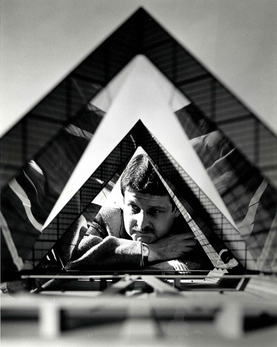
Stanley Tigerman, Instant City Model, 1966. Photo Balthazar Korab.
Displacement
Stanley Tigerman
Feb 15, 2012
(6pm)
Talk
Please RSVP
Stanley Tigerman will give a talk at the Graham Foundation in conjunction with the exhibition on his work, Ceci n'est pas une rêverie: The Architecture of Stanley Tigerman.
A Chicago native and principal in the architectural and design firm of Tigerman McCurry, Stanley Tigerman (b. 1930) has undertaken nearly 400 projects, resulting in more than 175 built works. Tigerman trained in some of Chicago’s top firms from 1949 until 1959 including the office of Keck & Keck, Milton Schwartz, and Skidmore, Owings & Merrill. Following his graduation from Yale University, where he received both his BArch (1960) and MArch (1961) under the leadership of Paul Rudolph, Tigerman established his own firm, working with several partners, before founding Tigerman McCurry Architects in 1986 with his wife Margaret McCurry. Tigerman is the author of seven books including The Chicago Tribune Tower Competition and Late Entries (1980); Versus: An American Architect’s Alternatives (1982); The California Condition: A Pregnant Architecture (1982); The Architecture of Exile (1988); Stanley Tigerman: Buildings and Projects 1966-1989 (1989); Schlepping through Ambivalence (2011); his autobiography Designing Bridges to Burn (2011), and he has edited numerous others. In addition to being chosen as was one of the architects to represent the United States at the 1976 and 1980 Venice Biennales, the work of Tigerman’s firm has been exhibited in major galleries and art museums around the world, including the Art Institute of Chicago, the Metropolitan Museum, and the Museum of Modern Art in New York.
In addition to his own work, Tigerman has demonstrated an unwavering commitment to advancing the discussion of architecture in Chicago for more than five decades. During this time he was a founding member of the critically engaged group The Chicago Seven; he was the director of the School of Architecture at the University of Illinois at Chicago between 1985 and 1993; and he co-founded ARCHEWORKS, a school and “socially oriented design laboratory” with Eva Maddox in 1994. Most recently, Tigerman co-curated the Graham funded exhibition Design on the Edge: Chicago Architects Reimagine Neighborhoods at the Chicago Architecture Foundation, featuring transit projects commissioned by the city’s top young design talent, and dedicated to the city’s new mayor Rahm Emanuel.
For more information on the exhibition, Ceci nʻest pas une rêverie: The Architecture of Stanley Tigerman, click here.

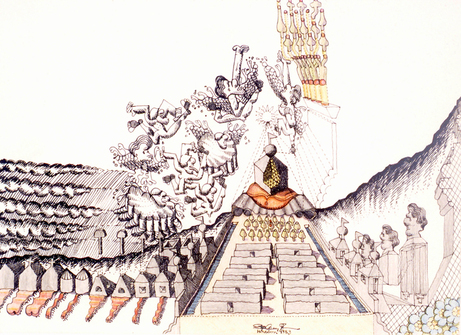
Stanley Tigerman, Architoon - Houston, 1983.
"Ceci ne'st pas une rêverie" Opening Reception and Lecture by Emmanuel Petit
Feb 02, 2012
(6pm)
Opening Reception
Join us for an opening reception with Stanley Tigerman and exhibition curator Emmanuel Petit.
5PM Lecture by Emmanuel Petit: "Scaffolds of Heaven: on Tigerman"
NOTE: RSVPS for Emmanuel Petit's Lecture are at capacity. To join the wait list, please click HERE. Unused reservations will be released to members of the wait list promptly at 5PM. Please join us for the opening reception from 6-8PM.
6-8PM Opening Reception
To RSVP to the opening reception, click HERE.
For more information on the exhibition, Ceci nʻest pas une rêverie: The Architecture of Stanley Tigerman, click here.
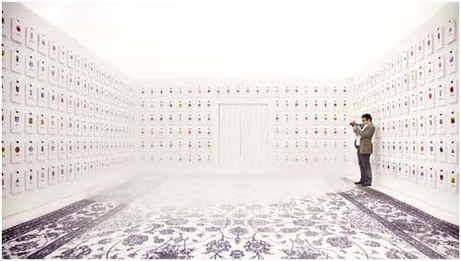
"Future on Pause," 2010 © Luis Urculo
Luis Urculo
Jan 25, 2012
(6pm)
Talk
RSVP Required
Madrid-based architect Luis Urculo will discuss his recent work. This talk is presented in partnership with Mas Context.
Luis Urculo's work is characterized by an unusual portrayal of architecture in the form of illustrations, animations, installations, and interiors. He studied at the ETSAM Madrid, at the Illinois Institute of Technology Chicago and at the Institute of Design and has collaborated with Alberto Campo Baeza, Mansilla-Tuñon and Izaskun Chinchilla. In 2006, he opened his own studio developing ephemeral architecture projects, stage designs and video-installations for Conde Nást, Philippe Starck and Sybilla, among others. His work has been exhibited at the XI Bienale di Architettura di Venezia, Montevideo Bienial, COAM Foundation and other locations. He also works as a teacher with Jaime Hayón for Master of European Design Labs at Instituto Europeo di Design, Madrid.
Graham Foundation Holiday Party and Book Sale
Dec 15, 2011
(5pm)
Please RSVP
Join us the evening of December 15th for refreshments and a book sale! All books will be discounted at least 15%, with some titles up to 60%. The Graham bookshop is a perfect place to find gifts for that architecture lover in the family (or for yourself!).
Book titles include:
Tomás Saraceno: Cloud Cities
The current exhibition catalog, Nancy Holt: Sightlines
G: An Avant Garde Journal of Art, Architecture, Design and Film
Clip/Stamp/Fold, ed. Beatriz Colomina
The Power of Pro Bono
Reveal: Studio Gang Architects
Living Archive 7: Ant Farm
The complete Words series from the Architectural Association in London
Schlepping Through Ambivalence: Essays on an American Architectural Condition by Stanley Tigerman
Bertrand Goldberg: Architecture of Invention
Architecture in Uniform: Designing and Building for the Second World War
The Complete Architecture of Louis Sullivan
+ more
Periodical selection includes:
Log Journal
Grey Room
Abitare
Mark
Detail
Design Quarterly
Monocle
Icon
Damn
Apartamento
+ more
Hope to see you there!
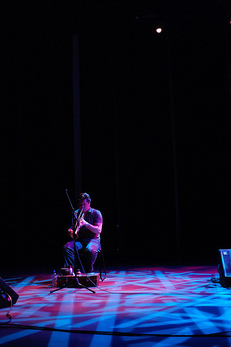
Photo: Susanna Bolle
Greg Kelley
Dec 03, 2011
(8pm)
Please RSVP
Lampo and the Graham Foundation are pleased to present Greg Kelley with his premier of Soft Delete/Purgative Dryness, a two-part piece exploring themes of philosophical and aesthetic absence, including the potential absence of meaning and content. The solo work will feature amplified but otherwise acoustic trumpet, in addition to other pre-recorded electronic elements.
Greg Kelley (b. 1973, Boston) began studying the trumpet at age 10. He attended the Peabody Conservatory of Music in Baltimore where, in addition to studying the conservatory curriculum, he immersed himself in the study of avant-garde and experimental music – eventually coming to the conclusion that his musical focus fell outside of the academic sphere. Kelley moved back to his native Massachusetts and inserted himself into the local avant-garde circles. Soon after, he commenced a period of intense travel and collaboration; bringing him across the United States and through Europe, Japan and South America.
Kelley has appeared on over 60 albums and plays in a number of groups including Nmperign (as abstract improvisatory duo and as horn section for ex-Galaxie 500-ers Damon & Naomi), Heathen Shame, the Undr Quartet and the BSC. Other collaborators have included Jandek, Keiji Haino, Donald Miller (Borbetomagus), Anthony Braxton, Kevin Drumm, Christian Wolff, Pauline Oliveros, Joe McPhee and Lionel Marchetti. In addition to playing the trumpet, he also has recorded music using electronics and musique concrète elements.
Kelley serves as the Minister of Fanfares for the Kingdoms of Elgaland-Vargaland, a so-called digital monarchy run by Leif Elggren that includes all areas of no-man's land, territories between national boundaries on both land and sea, digital and mental spaces.
This performance is presented in partnership with Lampo. Founded in 1997, Lampo is a non-profit organization for experimental music, sound art and intermedia projects. For information and to add your name to the Lampo list, visit http://www.lampo.org.


 PREVIOUS POSTS