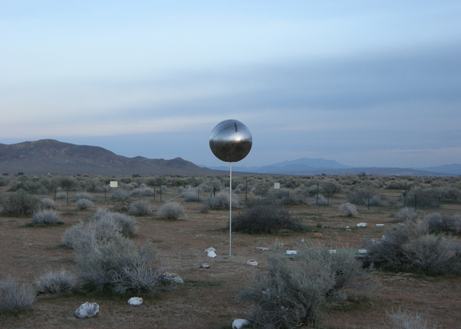
Desert Resonator, 2011. Sonic sculpture permanently installed at the CLUI Desert Research Station, Hinkley CA. Deborah Stratman and Steven Badgett.
Forces & Gazes
Deborah Stratman
Oct 20, 2011
(6pm)
Talk
Please RSVP
Framing lines of sight is an unavoidable part of the filmmaking practice. We encircle the gaze with a vectored view and we necessarily remove with every look, editing most of the world out in order to arrive at a shot. Considering the phenomenological power relationships that are native to this simple act are a central part of Stratman's practice. Equally central have been a commitment to landscape, infrastructure, socio-political histories and ways of knowing.
The talk will highlight resonances between some of Stratman’s recent (and future) projects and that of Nancy Holt. In particular, the recent public installations “Desert Resonator” and “Augural Pair,” (collaborations with artist Steven Badgett), and the in-progress “Sinkholes” project. Nancy Holt: Sightlines will be on view at the Graham Foundation from October 7 through December 17, 2011.
Deborah Stratman is a Chicago-based artist and filmmaker interested in landscapes and systems. Her films, rather than telling stories, pose a series of problems - and through their at times ambiguous nature, allow for a complicated reading of the questions being asked. Many of her films point to the relationships between physical environments and the very human struggles for power, ownership, mastery and control that are played out on the land. Most recently, they have questioned elemental historical narratives about freedom, expansion, security, and the regulation of space. Stratman works in multiple mediums, including photography, sound, drawing and sculpture. She has exhibited internationally at venues including the Whitney Biennial, MoMA, the Pompidou, Hammer Museum and any international film festivals including Sundance, the Viennale, Ann Arbor and Rotterdam. She is the recipient of Fulbright and Guggenheim fellowships and she currently teaches at the University of Illinois at Chicago.
For more information on the exhibition, Nancy Holt: Sightlines, click here.

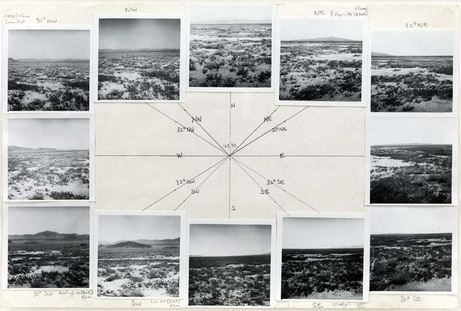
Nancy Holt, Preparatory drawing of “Sun Tunnels,” 1975, pencil and twelve black and white photographs on paper, 14 x 20 in.
Mining the Wasteland: Land Art's Legacy in Contemporary Art and Politics
Oct 08, 2011
(4pm)
Please RSVP
In conjunction with Nancy Holt: Sightlines, the Graham Foundation will host a panel discussion, artist talk and book signing on October 8th.
4 PM Panel Discussion: The panel will consider the wider influence of Land Art since the 1960s and 70s, and new perspectives on Nancy Holt’s interdisciplinary oeuvre through a critical rethinking of how the field has come to be defined.
Panelists:
Matthew Coolidge is the founder and director of the Center for Land Use Interpretation, an education and research organization based in Los Angeles, established in 1994. The work of the Center has been presented in museums, universities, and noncommercial exhibit spaces across the United States, and Europe. Coolidge teaches in the curatorial practice program at the California College of the Arts in San Francisco. He is the author and editor of several books, including Overlook: Exploring the Internal Fringes of America with the Center for Land Use Interpretation, Up River: Points of Interest on the Hudson River, and The Nevada Test Site: A Guide to the Nation's Nuclear Proving Ground.
Miwon Kwon is Professor of Contemporary Art History at UCLA. She is the author of One Place after Another: Site-Specific Art and Locational Identity (MIT Press, 2002) as well as numerous essays on an international roster of contemporary artists. She is currently organizing a historical survey exhibition with co-curator Philipp Kaiser entitled “Ends of the Earth: Art of the Land to 1974,” scheduled to open at LAMOCA in spring 2012.
Yates McKee is a PhD Candidate in Art History at Columbia University, and he teaches contemporary art at Cooper Union. His work on art, politics, and ecology has appeared in Grey Room, October, Art Journal, Artforum, Oxford Art Journal, Third Text and Texte Zur Kunst. Most recently, he contributed a text to the catalogue for Allora & Calzadilla's United States Pavillion at the 2011 Venice Bienale.
Ann Reynolds is an Associate Professor in the Department of Art and Art History and the Center for Women's and Gender Studies at the University of Texas at Austin. Her recent publications include essays on Blonde Cobra; Zoe Leonard's So you see I am here after all; Charles Simonds' Urban Dwellings; the politics of emotion; Parker Tyler; and feminist exhibitions and publics circa 1970. She is the author of Robert Smithson: Learning From New Jersey and Elsewhere (MIT Press, 2003) and is currently working on a book project entitled Home Movies: Creativity, Community, and Publics in New York, 1940-1970.
Branden W. Joseph (moderator) is The Frank Gallipoli Professor of Modern and Contemporary Art in the Department of Art History and Archaeology at Columbia University. He is the author of Beyond the Dream Syndicate: Tony Conrad and the Arts after Cage (Zone Books, 2008), Anthony McCall: The Solid Light Films and Related Works (Steidl, 2005), and Random Order: Robert Rauschenberg and the Neo-Avant-Garde (MIT Press, 2003). His writings have appeared in numerous scholarly journals, including Grey Room, a journal of architecture, art, media, and politics, published quarterly by MIT Press since 2000, of which he is a founding editor.
Alena J. Williams (Introduction) is the curator of Nancy Holt: Sightlines, the traveling exhibition on Holt's Land art, films, video, and related works from 1966 to 1980. She is a doctoral candidate in modern and contemporary art in Art History at Columbia University. Williams was a fellow in the postgraduate research group “Media of History – History of Media" at the Bauhaus-Universität Weimar and the recipient of the German Chancellor Fellowship from the Alexander von Humboldt Stiftung. Her publications include Nancy Holt: Sightlines (UC Press, 2011) and Light Is a Kind of Rhythm (merz&solitude, 2009).
7 PM Artist Talk: Nancy Holt will present an artist's talk, which will be followed by a book signing and reception.
"Mining the Wasteland: Land Art's Legacy in Contemporary Art and Politics" is co-presented with The Miriam and Ira D. Wallach Art Gallery, Columbia University.
For more information on the exhibition, Nancy Holt: Sightlines, click here.
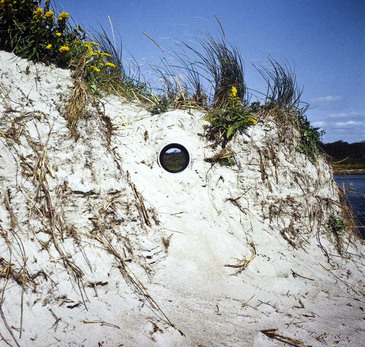
Nancy Holt, Views Through a Sand Dune, 1972, cement-asbestos pipe, sand, Narragansett Beach, Rhode Island.
"Nancy Holt: Sightlines" Opening Reception
Oct 07, 2011
(6pm)
Opening Reception
Please RSVP
Join us for an opening reception with Nancy Holt and curator Alena J. Williams.
For more information on the exhibition, Nancy Holt: Sightlines, click here.
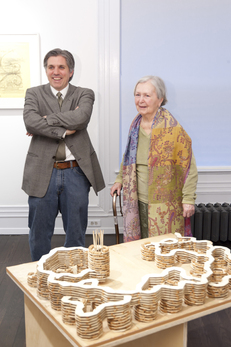
William Whitaker and Anne Tyng at the opening reception of "Anne Tyng: Inhabiting Geometry," Madlener House, Chicago, 2011 © Graham Foundation. Photo: James Prinz Photography.
"Anne Tyng: Inhabiting Geometry" closing reception and talk
William Whitaker
Jun 18, 2011
(4pm)
Please RSVP:
Celebrate Anne Tyng: Inhabiting Geometry on its closing day with a talk by William Whitaker. Whitaker, one of the exhibition organizers, will discuss the work of Anne Tyng, who he has worked closely with for many years. Whitaker brought Tyng’s work into the collection of the Architectural Archives of the University of Pennsylvania in 2005. A reception in the garden of the Madlener House will follow the event.
William Whitaker is the curator and collections manager of the Architectural Archives of the University of Pennsylvania—one of the leading repositories of architectural records in the world. He has organized and co-curated over 30 exhibitions, including retrospectives on Louis I. Kahn, Lawrence Halprin, Robert LeRicolais, Antonin and Noemi Raymond and most recently Wharton Esherick. In addition, Whitaker directed research for the landmark retrospective "Out of the Ordinary: the Architecture and Design of Robert Venturi, Denise Scott Brown & Associates", organized by the Philadelphia Museum of Art in 2000. Trained as an architect, he received his undergraduate degree from the University of New Mexico and Master's from the University of Pennsylvania where he teaches as a visiting lecturer in the Historic Preservation and History of Art departments.
The Architectural Archives of the University of Pennsylvania preserves the works of more than 400 designers from the 18th century to the present. For more information, click here.
For more information on the exhibition, Anne Tyng: Inhabiting Geometry, click here.
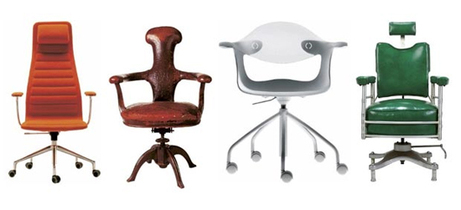
Jonathan Olivares, A Taxonomy of Office Chairs, 2011.
A Taxonomy of Office Chairs
Jonathan Olivares
Jun 14, 2011
(6pm)
Talk
Please RSVP
Over the last two hundred years, the office chair has attained cult-like status among the design community and office workers alike. From flexible back supports to mesh webbing, technological enhancements are constantly evolving to meet the changing requirements of the modern worker. With each new development, the office chair confirms its standing not only as an iconic object, but as an important status item.
Filling a significant gap in design history, A Taxonomy of Office Chairs presents the first exhaustive investigation into the office chair's aesthetic and technological evolution. The book features more than 130 of the most innovative chairs from the mid-1800's to the present day, including chairs by Frank Lloyd Wright, Marcel Breuer, Charles and Ray Eames, and Richard Sapper among other notable designers.
On June 14, Olivares will give a talk about his new book. A signing and reception in the garden will follow.
Jonathan Olivares is the founder of Jonathan Olivares Design Research (JODR). JODR is an industrial design office founded in 2006. The office is run on the belief that research and writing on design informs and provokes the design process, and identifies objective goals for it. In addition to providing design services JODR is engaged in sociopolitical and historical research for its clients, which include innovative producers of contemporary furniture and lighting, distinguished museums for design and art, and leading publications on design and architecture.
Olivares is a respected product designer, having designed a number of pieces of furniture for both Danese and Driade. Olivares has taught design workshops at ECAL in Lausanne, Switzerland, at ENSAD in Paris, France and has been a guest designer in the School of the Art Institute of Chicago's Designed Objects program. His products question conventional archetypes and define a culture of function that is specific for today's activity and technology. He recieved a grant from the Graham Foundation in 2010 for his research project, The Outdoor Office. He lives in Boston.
Related Links
Jonathan Olivares
http://www.jonathanolivares.com/

 PREVIOUS POSTS