Marcus Schmickler
Lampo Performance Series
Jun 11, 2011
(8pm)
Performance
Please RSVP
In 2002, Marcus Schmickler presented "<22-gliders>rule," a simulation of cellular automata transforming a string quartet at his Lampo debut. Since then, researchers at Germany’s Argelander Institute for Astronomy, have called Newton’s law of gravity into question.
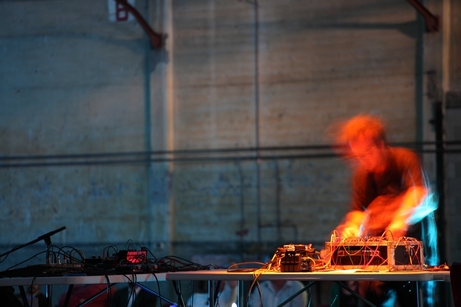
For his June 11 performance at the Graham, Schmickler takes up these questions in his continuing astronomic investigation, with "particle/matter-wave/energy," a new computer generated composition that asks the question: What does it sound like when galaxy clusters of 30 objects reciprocally influence each other by means of gravitation? Using a sonification of astrophysical data, Schmickler will collide first two, then three simulated galaxies.
Marcus Schmickler (b. 1968, Cologne, Germany) studied composition and electronic music and works in both composed and improvised forms. He has won numerous prizes and honors and is closely associated with the Cologne label a-Musik. As a composer along with his many works of electronic music, he works with the ensemble recherche, the Staatskapelle Weimar, the musikFabrik, the Paragon Ensemble, the Ensemble Zeitkratzer, among others. As a musician he works with artists such as John Tilbury, Thomas Lehn, MIMEO and Julee Cruise. His discography consists of over 50 titles, and he has performed internationally. He lives and works in Cologne.
Schmickler has appeared at Lampo several times–solo in September 2002, together with Thomas Lehn in September 2005, and again solo in December 2007 when he presented the U.S. premiere of "Altars of Science." In May 2009 Schmickler performed at Lampo with Peter Rehberg in the duo's first live appearance.
This performance is presented in partnership with Lampo. Founded in 1997, Lampo is a non-profit organization for experimental music, sound art and intermedia projects. For information and to add your name to the Lampo list, contact info@lampo.org or visit www.lampo.org.

The Center for Land Use Interpretation, Houston Petrochemical Corridor Landscan, 2010
Matthew Coolidge at the Museum of Contemporary Photography
May 26, 2011
(6pm)
Talk
Museum of Contemporary Photography
600 S Michigan Ave.
Chicago, IL 60605
Co-presented by the Museum of Contemporary Photography and the Graham Foundation, Matthew Coolidge, founder and director of the Center for Land Use Interpretation, Culver City, CA, will discuss innovative projects impacting the American landscape and built environment, followed by questions from Graham Foundation director Sarah Herda. This talk is presented in conjunction with the exhibition Public Works at the Museum of Contemporary Photography.
For more information, click here.
Anthony Pateras. Photo: Marco Fusinato
Anthony Pateras
Lampo Performance Series
May 20, 2011
(8pm)
Performance
Please RSVP
For his first Chicago performance, Anthony Pateras will present a new 4-channel work made especially for the occasion – an homage to Henri Chopin, using revoxed voice, manipulated Doepfer synthesizer recordings and prepared piano polyrhythms, performed in the dark.
Anthony Pateras (b. 1979, Melbourne, Australia) is a composer and performer from Melbourne, Australia. He is an idiosyncratic pianist, works with the Doepfer A-100 synthesizer and writes works for ensembles, orchestras and soloists. Pateras explores diverse musical interests through his projects: high velocity piano/drums explorations, electro-acoustic improvising ensembles, extended prepared piano pieces and immersive noise. He has performed or recorded with Han Bennink, Valerio Tricoli, Oren Ambarchi, Jim Denley, Paul Lovens, Fennesz, Thomas Lehn and The Necks. Previous groups include a decade-long duo project with Robin Fox, and the acclaimed free music trio Pateras/Baxter/Brown. He plays regularly throughout the world, and his music is released through the labels Tzadik (New York), Editions Mego (Vienna) and Lexicon Devil (Melbourne). He holds a PhD from Monash University.
This performance is presented in partnership with Lampo. Founded in 1997, Lampo is a non-profit organization for experimental music, sound art and intermedia projects. For information and to add your name to the Lampo list, contact info@lampo.org or visit www.lampo.org.
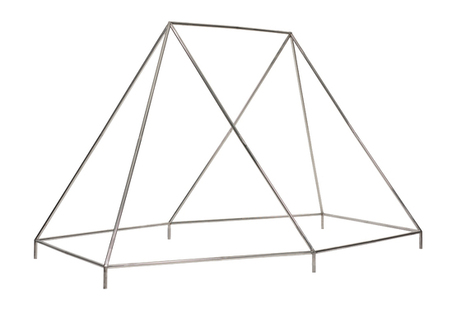
Jonathon Muecke, Frame, Polished stainless steel, 77 x 166 x 100"
Open Objects
Jonathan Muecke
May 14, 2011
(4pm)
Talk
Please RSVP
The Graham Foundation and Volume Gallery partner to present a talk by Jonathan Muecke in conjunction with Open Objects, his first solo exhibition. Rather than a collection, Muecke considers each of the objects in the exhibition to be its own project, the result being that every one is consistent to its counterparts only in its potential – “a quality that is itself immeasurable.”
Muecke’s projects reflect common forms of design and a continual pursuit of the meta-object. It is within this confrontation, between viewer and object, that development of new thought on functionality and materiality lives. Utilizing materials such as coal slag, glass sand, carbon fiber and gold foil, each piece works to remove our limitations of understanding and encourages the viewer to engage and interact.
A reception in the garden will follow the talk at 5PM.
Open Objects will be on view at Volume Gallery in Chicago from April 30 through May 15, 2011. Visit www.wvvolumes.com for more information.
Graham Foundation grantee Jonathan Olivares wrote about Muecke’s work in Abitare last October. To read the article, click here.
Jonathan Muecke lives and works in Minneapolis, Minnesota. He graduated from the Cranbrook Academy of Art in 2010, where from 2009-10 he was the Florence Knoll Scholar. In 2006 he received a Bachelors of Architecture from Iowa State University followed in 2007 by an internship at the architectural office of Herzog & de Meuron in Basel, Switzerland. In July of 2010 the jury of the Design Parade 5 (Hyéres, France) assigned him the Veuve Clicquot Award. His field of work circulates around the periphery of design.
Volume Gallery is an event-based gallery with a specific focus on American design, and a strong emphasis placed on emerging contemporary designers. The Volume Gallery releases editions, publications and organizes exhibits that showcase the work of American designers to regional, national and international audiences. The Gallery asks critical questions of what it means to be an American designer in a culture that is rapidly becoming more global, while simultaneously examining the American experience.
Related Links
Jonathan Muecke
http://jonathanmuecke.com/
Chicago, 2011
How Chicago Are You?
May 10, 2011
(6pm)
Panel Discussion
Please RSVP
How Chicago Are You? is an evening discussion that will explore the role of place in the production of creative works. Intended to provoke questions about the existence of a regional style, Chicago based practitioners from the fields of art, architecture, cartooning, design and music have been invited to present a selection of images that represent their perceptions about the strengths and pitfalls of the city in which they live and work. Through analysis and conversation, the group will explore whether location has led to trends in artistic production. Panelists include Eve Fineman, Pamela Fraser, Geoff Goldberg, Jimenez Lai, Alex Lehnerer, Damon Locks, Todd Mattei, Anders Nilsen, Robert Somol, and Dan Wheeler. The panel will be moderated by Paul Preissner.
EVE FINEMAN received her B.A. Cum Laude in Architecture from Washington University in St. Louis. After interning at the Smithsonian’s office of Exhibit Design and Production, she shifted her focus to interior environments and furniture design. She moved to Chicago in 1996 to pursue an MFA in Interior Architecture from the School of the Art Institute of Chicago on a full merit scholarship. There she explored the relationships between furniture, sound and the body through architectural installations and experimental furniture. Fineman is Associate Professor of Design at the Illinois Institute of Art, Chicago, where she has been teaching full-time since 2002.
www.evefineman.com
PAMELA FRASER is an American painter. She received her BFA in painting (1988) from the School of Visual Arts in New York and her MFA in New Genres (1992) from UCLA. She has exhibited nationally and internationally and is represented by Casey Kaplan Gallery in New York. Fraser’s solo exhibitions include Galerie Schmidt Maczollek in Cologne, Galleria Il Capricorno in Venice, Asprey Jacques in London, Vedanta Gallery in Chicago, and Casey Kaplan in New York.
www.pamelafraserstudio.com
GEOFF GOLDBERG has practiced in complex urban and architectural projects for 25 years. A native Chicagoan, he has been teaching design and technology at UIC since 1994. He founded his office in 1992 engaging both architecture and urban design projects. Geoff has an M.Arch. from Harvard University’s Graduate School of Design (1982), a BA from the University of Chicago (1977). He has worked in the offices of I.M. Pei, Bertrand Goldberg, and the Mayor of Chicago, and is currently working on publications on Marina City and mid-20th century Italian mechanical engineering.
www.arch.uic.edu
JIMENEZ LAI is currently Clinical Assistant Professor at University of Illinois at Chicago. He graduated with an M.Arch. from University of Toronto. Previously, Lai lived and worked in a desert shelter at Taliesin, AZ, and resided in a shipping container at Atelier Van Lieshout on the piers of Rotterdam. Lai has received mentions in competitions in Japan, Europe and the US. Professionally, Lai has worked for MOS, AVL, RE X, OMA /Rem Koolhaas in Rotterdam and New York. In spring, 2011 he exhibited a large scale installation in LOT Gallery in Louisville, Kentucky.
www.bureau-spectacular.net
ALEX LEHNERER is an architect and urban designer, received his PhD from the ETH in Zurich and is currently based in Chicago where he holds a position as Assistant Professor at the University of Illinois, School of Architecture. He is partner of Kaisersrot in Zurich, CH, and ALSO Architekten, and the director of the Department of Urban Speculation in Chicago. While appreciating the city as a panoramic projection, his practice explores urban and architectural conditions - their forms, ingredients and rules. This is done both in an academic and professional environment.
alexlehnerer.com
DAMON LOCKS is the frontman for the band the Eternals, creates digital prints, silkscreens and relief prints that play with two sides of “invisibility,” depicting neglected urban spaces, overlooked perspectives and marginalized people, while also envisioning cities not yet visible. Some of his images recombine elements of Chicago, putting train tracks, buildings and buses in new and provocative relations. Locks’ printing process gives these pieces the scabrous texture of cracking brick and concrete, while the hues—in everything from faded walls and smudged “newsprint” to supersaturated skies—endow them with an aura of nostalgia for things to come. From desolate to populous, disconsolate to euphoric, the cityscapes and inhabitants imagined here provoke questions about race, urban planning, and socioeconomic disparity, all oriented around a hope summed up in the words emblazoned on one print: “Tomorrow starts today.”
www.damonlocks.com
TODD MATTEI is an artist and musician. He received his MFA in Film/Video/Animation with Honors from Unniversity of Illinois at Chicago in 2005. His individual and collaborative art work has been exhibited in Chicago and the US since 2003. He was a member of the Chicago band Joan of Arc and has produced video and music pieces for film and commercial videos.
www.toddmatteiart.com
ANDERS NILSEN is a popular artist and graphic novelist who grew up in Minneapolis and lives in Chicago, IL. He works on an ongoing comic series, Big Questions (Drawn and Quarterly), which has been nominated several times for the Ignatz Award. In addition, his comics have appeared in the anthologies Kramers Ergot and Mome. His graphic novel Dogs and Water won an Ignatz Award in 2005. An excerpt from Dogs and Water was featured in the inaugural 2006 edition of the Best American Comics anthology, and the book was expanded and reissued in hardcover in 2007. Other, more recent works include a graphic memoir, Don't Go Where I Can't Follow and a comic The End.
www.andersbrekhusnilsen.com
ROBERT SOMOL was appointed Director of the School of Architecture at the University of Illinois at Chicago in 2007. An internationally recognized design theorist, Somol was most recently Professor in the Knowlton School of Architecture at Ohio State University and Visiting Professor at the Princeton School of Architecture, and taught design and theory at the University of California, Los Angeles, from 1997-2005. He has served as the Max Fishman Visiting Professor at the University of Michigan and the Cullinen Professor at Rice University, in addition to teaching at Columbia University's GSAPP and Harvard's Graduate School of Design. Somol is the editor of Autonomy and Ideology (Monacelli Press, 1997) and has served on the editorial boards of Any and Log. His writings have appeared in publications ranging from Assemblage to Wired, and focus on modernism and its modes of repetition, the emergence of the diagram in postwar architecture, landscape and interior urbanism, and the development of graphic or cartoon protocols within contemporary architectural practices. He is the co-designer of "off-use," an award-winning studio and residence in Los Angeles that extends his interest in combining the speculative discipline of modernism with the material excesses of mass culture: beinahe nichts meets la dolce vita. As an architectural designer, writer and educator, Somol is a central figure in efforts to displace architecture's modes of criticality by a renewed engagement with the projective ambitions of the discipline. His collection of essays, Nothing to Declare, is forthcoming from ANY Books and the MIT Press, and he is a member of the Research Board of the Berlage Institute in Rotterdam.
www.arch.uic.edu
DAN WHEELER, FAIA has taught as an Adjunct Associate Professor within the School of Architecture since 1992, being elevated to Associate Professor in 2001. He teaches design, building science, drawing, and design/build. He served as the Interim Director of the school from 2006-7. He is co-author with Clinical Associate Professor Bill Worn of the schools integrated design/building science curriculum. He is past Interim Director of the Graham Foundation for Advanced Studies in the Fine Arts, and remains on the Advisory Board of the Chicago Architecture Club and the Marwen Foundation. Professor Wheeler lectures both nationally and abroad. Wheeler is a practicing architect and is a principal of the Chicago firm Wheeler Kearns Architects. Work of the firm is regularly in print, including the monograph Wheeler Kearns Architects, Ten Houses (1999).
www.wkarch.com
PAUL PREISSNER is an architect and teacher, receiving his undergraduate education in architecture from the University of Illinois and his M.Arch. from Columbia University in New York. He worked for Peter Eisenman, Philip Johnson and Skidmore Owings and Merill, before establishing his own office in 2006. Currently, he is Assistant Professor and the Coordinator of the Master of Architecture program at the University of Illinois at Chicago. His professional practice has developed an international profile through a recognized œuvre of commissioned and competition projects, all of which explore design’s highly visual relationship with its audience. In 2006 he was awarded the second prize in the international open competition to design the Museum of Korean Pre-History in the Gyeonggi-do Provence of South Korea. His architectural work been published and exhibited worldwide and is part of the permanent collection of the Art Institute of Chicago. He and his wife live in Chicago with their dog, Klaus.
www.paulpreissner.com



 PREVIOUS POSTS